There was a time when “getting found online” meant exactly one thing – showing up on Google. Simple. One acronym to learn, one strategy to chase. That time is over.
Today, a potential customer might type a search into Google, ask ChatGPT for a recommendation, or just ask their phone out loud while doing something else entirely – and each of those moments works on completely different rules. Three acronyms now govern how your brand gets discovered: SEO, GEO, and AEO. They sound similar enough to blur together, but they’re doing three genuinely different jobs – and a brand that only nails one of them is only getting found a third of the time.
Let’s untangle exactly what each one does, and why you can’t really afford to ignore any of them. 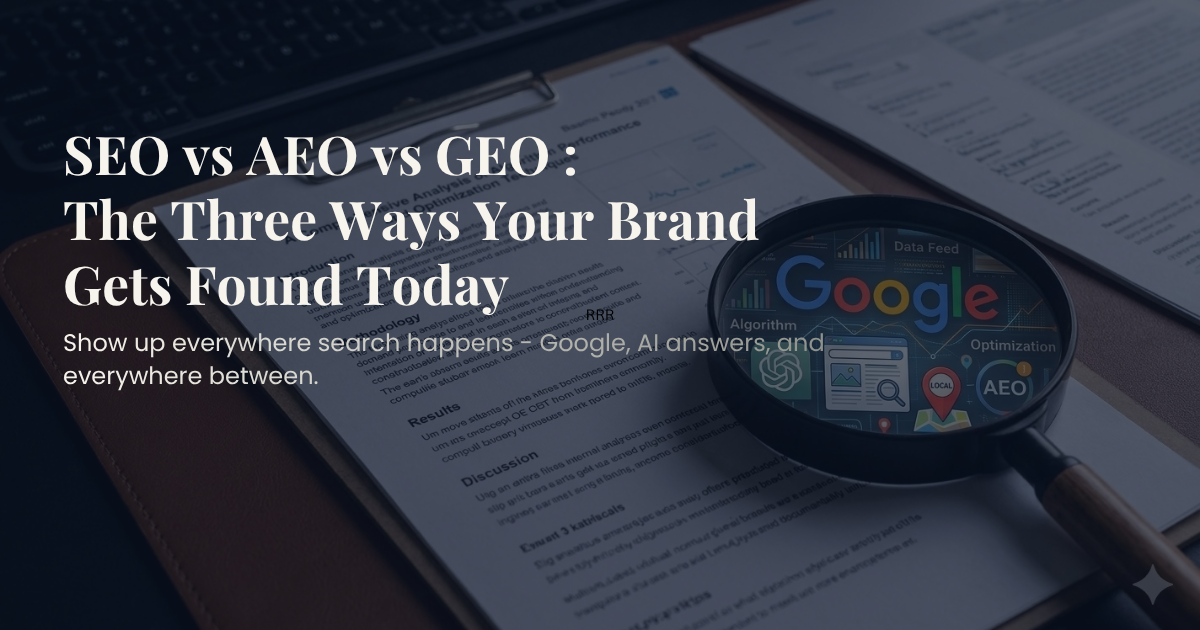
First – the Quick Definitions
SEO – Search Engine Optimization. Getting your website to rank well on traditional search engines like Google, so it shows up as one of the clickable results on a search page.
GEO – Generative Engine Optimization. Getting your brand mentioned, cited, or recommended inside an AI – generated answer from tools like ChatGPT, Gemini, or Google’s AI Overviews – where the customer reads one synthesized response instead of browsing a list of links.
AEO – Answer Engine Optimization. Getting your content structured clearly enough to become the direct, spoken, or displayed answer to a specific question – through voice assistants, smart speakers, or featured answer boxes.
Same underlying goal – being discovered – but three completely different formats, and three different sets of rules for winning.
How They’re Actually Different
What the customer gets: With SEO, the customer gets a list of links and has to click through and decide for themselves. With GEO, the customer gets one AI – written answer that weaves together information from a few trusted sources. With AEO, the customer gets one direct, extracted answer – often read aloud or shown in a single answer box, with no browsing at all.
How much the customer has to work: SEO assumes people are willing to browse and compare. GEO assumes people want a summarized answer, but might still investigate further. AEO assumes people want the answer immediately, with zero extra steps – this is often the voice – search, “just tell me” mindset.
What actually earns you the spot: SEO rewards technical health, backlinks, and keyword- matched content. GEO rewards clarity, consistency, and being genuinely citation-worthy across the web. AEO rewards content that can stand alone as a complete, correct, plainly worded answer to one specific question.
How many “winners” there are: A Google results page has ten – plus spots – there’s room to rank on page one without being the top result. GEO narrows that down to a handful of sources the AI actually chooses to reference. AEO narrows it down even further – often, there’s just one answer given. It’s less a leaderboard and more a single trophy.
Why a Brand Needs All Three, Not Just One
Here’s the part that trips brands up: these three aren’t competing tactics where you pick a lane. They’re three different customer moments, and your brand needs to show up in all of them.
Someone might Google your category and scroll through results (SEO). Someone else might ask an AI chatbot to recommend a good option and never click a single link (GEO). A third person might be doing something else entirely and just ask their smart speaker out loud, expecting one clean answer (AEO). Same intent, three completely different paths to the exact same purchase decision – and a brand optimized for only one of them is invisible in the other two.
This isn’t a hypothetical. It’s already how a growing share of your future customers are behaving, right now, today.
The Good News: They Build on Each Other
You don’t need three separate strategies running in parallel – because in practice, good SEO is the foundation the other two are built on top of.
- Start with strong SEO fundamentals – technical health, relevant content, real backlinks. This is the base layer AI tools and answer engines often pull from anyway.
- Layer GEO on top – make sure your information is consistent, clearly written, and genuinely citation-worthy across the web, so AI tools trust you enough to reference you.
- Structure content for AEO – lead with direct answers to specific questions, in clean, scannable formatting, so that content can be lifted out and used as a stand-alone answer.
Do this well, and the same well – written, well – structured page can quietly work for all three at once – ranking on Google, getting cited by AI, and getting read out by a voice assistant, without three separate content strategies pulling in different directions.
The Real Question to Ask About Your Brand
It’s no longer just “do we rank on Google?” The fuller version of that question now looks like this: if a customer searches, if they ask an AI for a recommendation, and if they ask a voice assistant out loud – are we showing up in all three? Or just the one we happened to think about?
Most brands are only playing one of these games right now, simply because the other two are still new enough to overlook. That’s exactly why this is the moment to stop overlooking them – being early to SEO once built real, lasting advantages for the brands that took it seriously. GEO and AEO are that same window, wide open, right now.
Want your brand showing up whether customers search, ask AI, or ask out loud? Adnotica builds SEO, GEO, and AEO together as one connected visibility strategy – not three separate afterthoughts. Get in touch with us to see where your brand currently stands.